Ukrainian local authorities and community initiatives will receive support in developing green energy communities
Over the coming year, Ukrainian local authorities and community groups will be able to take part in training on setting up green energy communities, and two selected local authorities and two community groups will receive expert support.
By combining educational activities, expert planning sessions and support for pilot initiatives, the project “Shared Energy: Building Green Energy Communities in Ukraine” establishes a comprehensive and systematic process for developing and scaling up energy community models that are both locally adapted and suitable for replication across Ukraine.
The project will begin with the establishment of a national Expert Working Group, comprising up to 10 specialists in the technical, legal, economic, cooperative and social sectors. This interdisciplinary group will serve as a knowledge hub and advisory body throughout the project’s implementation.
As part of the project, the team:
- prepare an analytical catalogue proposing various models for establishing green energy communities in Ukraine;
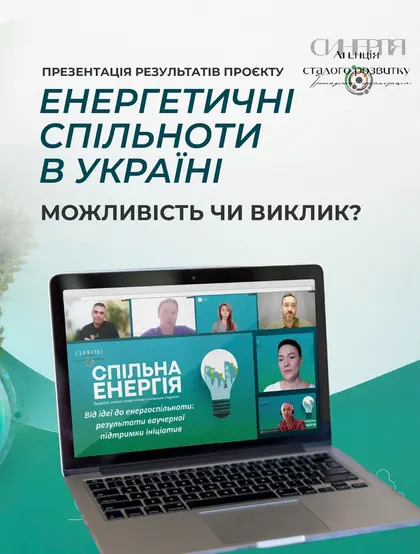
- develop a comprehensive online course on establishing green energy communities, which interested municipalities and private initiative groups will be able to undertake;
- based on the results of the training, two municipalities will be selected to receive assistance in developing a roadmap for the implementation of green energy communities;
- furthermore, based on the training results, two private initiative groups (for example, housing associations, hospitals, schools, etc.) will be assisted in developing business plans or technical documentation for the creation of green energy communities.
Why is this important?
The ongoing war in Ukraine has led to unprecedented damage to the country’s centralised energy infrastructure. Since 2022, targeted attacks on the power grid have damaged or destroyed over 65% of Ukraine’s regulated generating capacity, causing widespread power cuts, heating failures and disruptions to water supplies. These problems are particularly acute in winter, affecting the lives of millions of civilians and the operation of critical facilities.
The situation has laid bare the vulnerability of Ukraine’s centralised energy model and highlighted the urgent need to create a more resilient and decentralised system. At the same time, a unique opportunity is opening up for the country: to build the energy system of the future — one that is decentralised, inclusive and resilient to risks.
One of the most effective models for deploying renewable energy at the local level is energy cooperatives and community energy projects. Such models, which allow citizens and municipalities to jointly develop, own and manage renewable energy infrastructure, are already being widely implemented across Europe and supported through the EU’s Clean Energy Package.
Although Ukraine already supports the development of energy cooperatives through existing legislation and green tariffs, new legislative initiatives are aimed at expanding community energy models, indicating growing recognition and support for energy communities at the state level. At the same time, current laws do not yet fully implement European directives on energy communities.
Furthermore, Ukraine currently lacks adapted models of EU best practices, documented pilot projects, or national coordination to support such initiatives. Despite significant public interest, energy communities in Ukraine remain largely undeveloped.
Therefore, the project “Shared Energy: Building Green Energy Communities in Ukraine” will contribute to the development and scaling up of community-led ‘green’ energy initiatives in Ukraine by adapting proven European business models, building local capacity, piloting practical solutions in selected communities, and creating a supportive ecosystem for long-term energy sustainability, community participation and decentralised renewable energy production.
The project “Shared Energy: Building Green Energy Communities in Ukraine” is being implemented by the Synergy Sustainable Development Agency with the support of the European Climate Fund.